This interview has been edited for length and clarity.
When did your family live in Shanghai, where were you living and what brought your family to Shanghai in the first place?
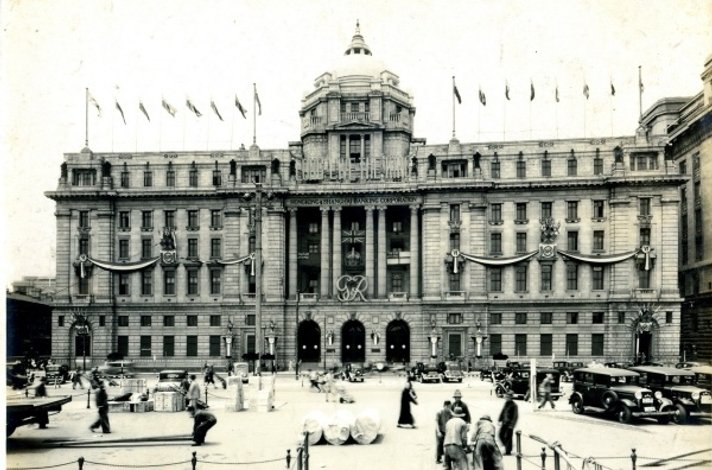
My father came to Shanghai in 1936 as an employee of the HSBC. He had got engaged to my mother whilst on leave from Hong Kong, back home in Dumfries. The Rigg family moved there from Kirkcudbright after the death of his father in 1926. Between arriving in Shanghai and getting married in November 1939, he lived in one or two Bank Messes. My parents then lived in the HSBC Compound at 125, Avenue Haig, aka – corner of Haigey Lu and Fochey Lu (Avenue Foch). I was born in August 1941 in the Country Hospital on the same day as my lifelong friend Barrie Martin.
[Note: John’s house would have been close to the junction of what is now Hua Shan Lu and Yan’an Zhong Lu]
The period leading up to the Japanese internment must have been a very tense time in the community. Did your family try to leave China or was there nowhere else to go because of the war?
As you can imagine, I have absolutely no memory of my life in Shanghai. I do know that in the mad rush for berths on ships out of Shanghai, my mother was offered a place, but declined to take it up. The men in the banks and other businesses were not permitted to leave. I notice in the Merchistonian Register (I was also at Merchiston Castle School in Edinburgh) my father’s entry reads – Interned in Shanghai 1941-45 – thus I am not certain as to the technical aspects, such as were we under house arrest apart from working hours, or should that have read 1943 when we were all put in what the Japanese politely termed Civil Assembly Centres?
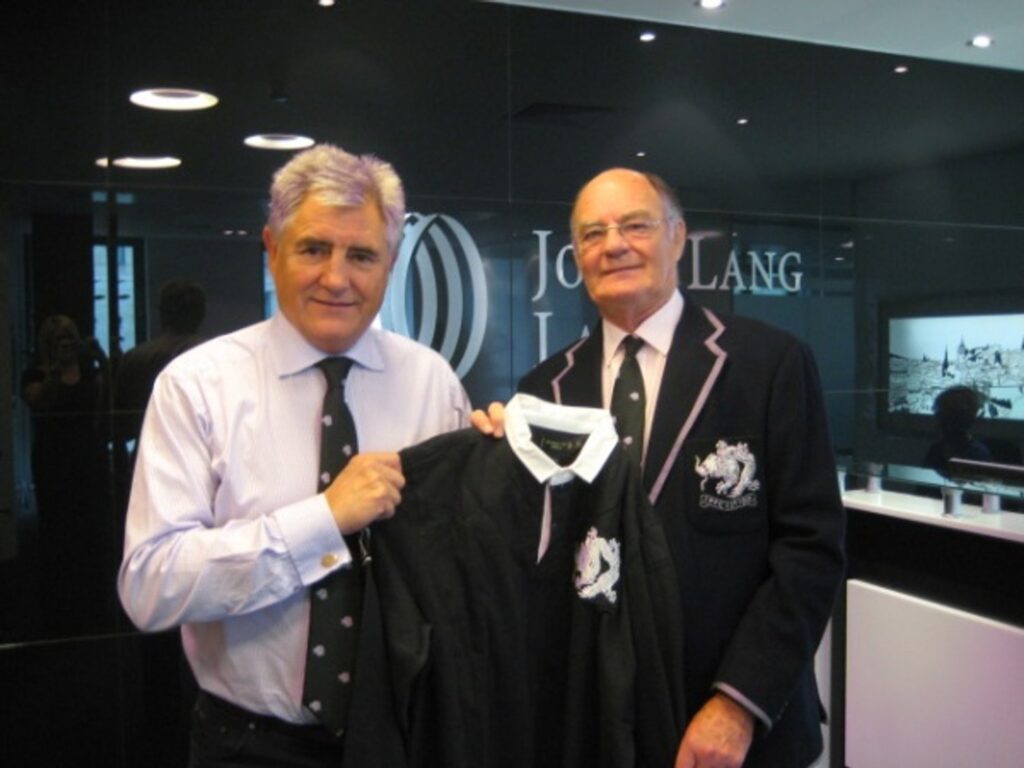
Your father’s rugby shirt was the basis for the design of the current Shanghai Scottish shirts. Can you share with us some details of his playing career in Shanghai?
My father played in Hong Kong for the HSBC and was also selected to play for the Colony in the Interport Match of 1932 versus Shanghai. He first played for Shanghai in their second team against the Association Sportif team in November 1936. He quickly found his way into the first XV. Simon (Drakeford) has documented a further 33 games he played in Shanghai for both the club and for Shanghai Scottish. Included in the games above were many of the big fixtures of the day against for example the US Marines 1st XV, the Royal Welsh Fusiliers 1st XV, the Combined Services, Durham Light Infantry 1st XV, the British Army and the French Army.
He played Interport for Shanghai against Hong Kong and also against the United Services in February 1939 in Hong Kong. Barrie’s dad was the reserve but did not play. The Hong Kong team was captained by Barrie’s uncle, H D Bidwell, who had previously represented Shanghai against my father in the 1932 match. The last game my father appears to have played in was for the SRUFC “Have Beens” in December 1939.
Do you have any idea of the size of the Scottish community in Shanghai during the time your family lived here? Were there any well known Scots amongst the community at the time?
I will try and get the answer to that, but I would imagine there would have been a few thousand. I cannot honestly say if one of China’s most famous and admired Scots, Eric Liddlell (Chariots of Fire), actually spent any time in Shanghai. He lived mainly in Tientsin and was known as China’s Olympian.
We understand you are a very keen golfer as was your father. Please share some highlights of your golfing exploits?
Father had a good golf record, having won numerous Bank and Club competitions. I think he got to the Final of the Malayan Championships and also, whilst on leave in 1936, he won a Lucifer Trophy for the lowest round on the final day of the British Empire Trophy, bettering the eventual overall winner, a certain Mr Bobby Locke. His lowest handicap was Scratch at Shek’O in Hong Kong in the late 1950’s. My claim to fame is very modest. My lowest handicap was 13, I won the British Rotary Matchplay Championship – a handicap event – at Woburn, and I have the honour and privilege of being a Member of the Honourable Company of Edinburgh Golfers who play at what is currently the Worlds No 1 golf course, Muirfield. I am probably better know as The Hickory Renaissance Man, having started the resurgence of interest in hickory tournament golf in Britain in 1985. As a result of that, hickory golf tournaments now take place all over Europe. As a member of the British Golf Collectors Society since inception, I am always seeking information on my favourite but elusive topic, golf in pre war China.
You once mentioned that a private individual had their own golf course in Shanghai. What was the story behind that.
Barrie Martin’s Great Grandfather Augustus White was a broker in London. As a young man he came to Shanghai and prospered to the extent that in the 1890’s he built himself an estate, which he named Clatterbourne, in the region of Siccawei near what was to become the far end of Avenue Haig. Barrie informs me that, apart from a nine hole golf course, in order to keep all the weekend party guests entertained, there were also twelve tennis courts. How the Shanghailanders of the late nineteenth and early twentieth centuries managed to survive the weekends one doesn’t know. Golf, rugby, cricket, horse riding, paper chase, swimming, tennis plus a formal dinner dance with the attendant eating, drinking and smoking must have shortened anybody’s life expectancy! It is not known as to exactly when the house was demolished but it is thought to be in the mid 1920’s for development.